3rd Poem: Es Devlin, Come Home Again unfolds through a series of crossings: from books into reflections, from human figures towards other forms of life, from the intimacy of the sketchbook into the scale of architecture, and from artificial illumination towards daylight and the garden. Each work changes the terms through which the next is encountered. Knowledge remains partly unread; reflections do not settle into a single viewpoint; the city expands beyond its human inhabitants. Across this sequence, Devlin creates a shared space without presuming that everything within it can be fully known, translated or brought into agreement. The exhibition asks what forms of attention might emerge when proximity is allowed to retain distance, and when relations remain unfinished.
1. A Choreography of Absences
The exhibition begins in a library, although the books do not initially offer themselves to reading. They are inverted, their pages and titles withheld, while drawings and moving images pass across the shelves. Libraries hold knowledge, yet this one does not make that knowledge immediately available.
Libraries recur throughout Devlin’s work as places where absent voices acquire a present form. A book carries someone’s thought beyond the time and place of its making, though the encounter it offers is never complete. Infinite Library gives spatial form to this condition of absent authors and unreachable contents. The books are close enough to touch, but resistant to straightforward access. Their inversion does not empty them of significance but adds weights to their presence.
This seems to have particular resonance at a time when knowledge is expected to arrive quickly and visibly. Search engines, digital archives and artificial intelligence promise to bring expanding bodies of information within reach. The world appears increasingly searchable, translatable and available for retrieval. Yet greater access does not necessarily produce greater understanding. Information can travel without its histories, just as words can be detached from the lives and conditions that gave rise to them. Within Devlin’s library, knowledge retains a degree of privacy. The books do not surrender everything they contain. They suggest that an encounter may begin before comprehension, and that relation can continue in the presence of what remains unread.
A door gradually appears within this surface. The projected bookshelf opens, and the visitor walks through the image. A structure associated with stillness becomes mobile; a wall of bookshelves becomes a passage; the act of looking develops into an act of crossing. One enters the picture at the moment when it becomes architecture.
2. Beyond Immersion
On the other side lies Mirror Maze. The apparent clarity of the mirror gives way to a more unstable field. Bodies and architecture are multiplied; one reflection interrupts another; distance becomes difficult to measure. The mirror returns an image while withholding certainty about where that image belongs.
The self appears in and among strangers. Other people enter as reflections before appearing as a body in the room, while one’s own image seems to be perpetually disappearing. Seeing becomes inseparable from being seen, and the apparently personal act of perception acquires a collective relation.
The mirror is often associated with self-recognition, yet this maze complicates any secure return to the self. The reflected figure is dispersed across surfaces already occupied by other figures, lines and viewpoints, and identity appears interdependent without becoming interchangeable. The presence of others changes the image one occupies in the space, even when those others remain unknown. Connection does not depend upon immediacy or the removal of ambiguity. It can remain incomplete and still matter.
The threshold between library and mirror is therefore more than a transition between installations. It proposes a way of moving through the exhibition. One crosses into the presence of others without expecting them to become entirely legible. A common space begins to form, composed as much from intervals as from encounters.
3. Excessive Archiving
In Screenshare, hundreds of pages from Devlin’s sketchbooks gather into a large moving image. Drawings, observations, fragments of text and traces of earlier projects appear in succession. The private scale of the page expands across the architecture, while the movement of the image prevents any single page from becoming definitive.
The sketchbook occupies an uncertain place within an artistic practice. It may record the early formation of a work, continue alongside its production, or preserve possibilities that the realised project left behind. An intimate thought may sit beside a technical instruction. A remembered image may coexist with a practical measurement. Forms that later become monumental first appear within the reach of the hand.
When sketchbooks enter exhibitions, they are often expected to explain. They seem to promise access to origins: the initial idea, the artist’s intention, the concealed route towards a finished work. Screenshare complicates this expectation. Its volume and motion make the archive impossible to master. The work opens the archive while sustaining its excess. The archive moves through recurrence, interruption and revision.
This movement also opens Devlin’s practice beyond the narrative of the solitary artist. Every realised project emerges through collaboration with performers, engineers, musicians, architects, fabricators, technicians and audiences. The sketchbook may bear the trace of one hand, but the environments towards which it points are collective constructions. Enlarged within the gallery, its pages occupy a space between personal memory and shared production.
Sharing consequently involves a degree of relinquishment. Once an image circulates, it cannot remain unchanged or belong entirely to its point of origin. The archive becomes a temporary rather than a stable repository. It passes from hand to page, page to screen, private record to public image, and exhibition to the life beyond it. At each stage, something travels and something remains behind. The work persists through this incomplete transmission.
4. Parallels
In Come Home Again, drawings and cutouts of animals and plants from London and Seoul inhabit a shared structure of image, voice, light and sound. The city emerges as a home whose occupants exceed those recognised by its human maps. The species gathered by Devlin do not produce a seamless picture of ecological coexistence. Each carries its own scale, habitat, duration and vulnerability. Some have adapted to proximity with human life; others survive at its margins; others approach disappearance. They occupy the same work without sharing the same conditions.
Drawing is crucial to this encounter. It begins with observation, with the effort to follow the particular structure of a wing, leaf, eye or limb. Yet drawing also leaves visible the distance between image and living body. The drawn animal can never be the animal itself. This gap registers the limits of human access and the care required in approaching another form of existence.
The movement between London and Seoul similarly resists any simple passage between the local and the universal. Species belong to particular climates, habitats and histories. Bringing them into relation does not make those contexts interchangeable. The two cities meet through resemblances and differences, through forms of life that share a planet without necessarily inhabiting the same perceptual world.
“Home” consequently becomes more difficult to define. It may be a building, city, language, ecosystem or arrangement of memories. It is intimate yet distributed, made through relations that no person can fully perceive. To recognise a city as a shared habitat is to recognise that many of its inhabitants remain outside the usual structures of visibility.
The understanding of relation also reshapes Devlin’s conception of a “temporary society”. A society formed within an exhibition need not possess a common identity or arrive at a shared interpretation. It may consist of parallel experiences, uneven knowledge and momentary acts of attention. Its members cross the same rooms, though the exhibition encountered by each remains different.
The gathering extends beyond those physically present. It includes voices carried by books, lives evoked through drawings, cities connected across distance, and species whose absence has become one condition of their visibility. The work holds these presences together without forcing them into a single order. What emerges is a collective field composed through difference. Its coherence remains provisional. Its inhabitants are neither wholly separate nor absorbed into a larger whole. They become perceptible through their relations while retaining lives and histories beyond the frame.
5. A Line Towards the Unseen
The exhibition’s final movement gathers around Line of Light, where illumination becomes material and measure. A beam divides the space while remaining intangible. It becomes visible through the surfaces it touches, the air it cuts and the changing sensitivity of the eye. The work began with the memory of waking in an unfamiliar room and perceiving a single line of light. A line may indicate the edge of a curtain, the boundary of a door or the first arrival of morning. Before revealing the room, it makes the unknown more palpable.
At FUTURA SEOUL, Line of Light opens towards the garden and embraces a pool of water. Artificial illumination within the gallery opens up to relation with daylight outside. The two lights keep different kinds of time. One can be controlled, repeated and calibrated. The other changes with weather, season and hour. Their meeting produces no final image but unfolds as a continuing adjustment. Daylight changes the exhibition without becoming one of its objects. It reaches the architecture at different angles, alters reflections and gradually diminishes. The gallery becomes a membrane through which time and atmosphere pass.
The work brings the act of looking into awareness. The eye adjusts, the body changes position, and the gallery space appears differently from one moment to the next. Attention emerges as responsiveness to changing relations. Whatever is illuminated remains accompanied by what lies in shadow, beyond the window or outside the visitor’s field of vision. Such partiality gives perception depth. A world in which everything was equally visible would offer no distance, orientation or discovery. Here, obscurity participates in the way the space becomes present.
Reflected in water and altered by fading daylight, the garden becomes image, habitat and duration at once. It can be entered visually without being possessed. There is no untouched exterior waiting at the end of the sequence. Instead, the relations rehearsed inside continue through another arrangement of surfaces, lives and times.
The movement towards the garden remains a crossing rather than an arrival. The artificial line meets daylight without becoming indistinguishable from it. Architecture opens onto landscape while retaining its boundary. The visitor nears the outside at the moment when distinctions between inside and outside become most active.
Devlin’s works create relations that remain partial, mobile and open to revision. Their temporary society is held together less by common understanding than by a willingness to share space with what exceeds it. To come home again, in this sense, is to return with a changed awareness of home: as a place composed through strangers, memories, materials and forms of life that were never ours to contain.
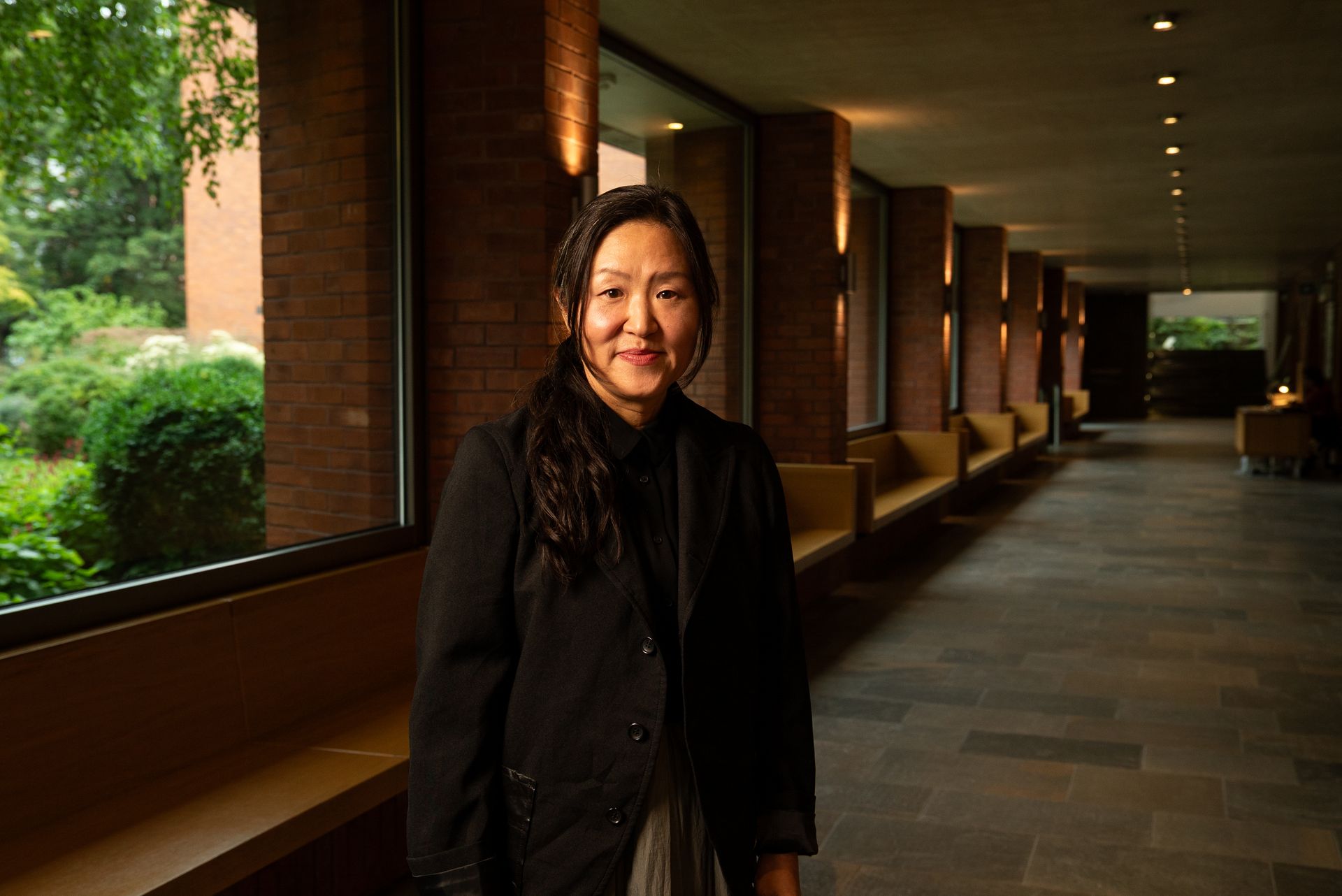
Prof. Sook-Kyung Lee is Director of the Whitworth and Professor of Curatorial Practices at The University of Manchester, advocating global art histories and transnational curating. Lee was Senior Curator, International Art at Tate Modern, Artistic Director of the 14th Gwangju Biennale, the Commissioner & Curator of the Korea Pavilion and the Curator of the Japan Pavilion at the 56th and 60th Venice Biennale. She also served as a jury member for the Turner Prize, Nam June Paik Art Prize and the Paul Hamlyn Awards for Artists.


3rd Poem: Es Devlin, Come Home Again unfolds through a series of crossings: from books into reflections, from human figures towards other forms of life, from the intimacy of the sketchbook into the scale of architecture, and from artificial illumination towards daylight and the garden. Each work changes the terms through which the next is encountered. Knowledge remains partly unread; reflections do not settle into a single viewpoint; the city expands beyond its human inhabitants. Across this sequence, Devlin creates a shared space without presuming that everything within it can be fully known, translated or brought into agreement. The exhibition asks what forms of attention might emerge when proximity is allowed to retain distance, and when relations remain unfinished.
1. A Choreography of Absences
The exhibition begins in a library, although the books do not initially offer themselves to reading. They are inverted, their pages and titles withheld, while drawings and moving images pass across the shelves. Libraries hold knowledge, yet this one does not make that knowledge immediately available.
Libraries recur throughout Devlin’s work as places where absent voices acquire a present form. A book carries someone’s thought beyond the time and place of its making, though the encounter it offers is never complete. Infinite Library gives spatial form to this condition of absent authors and unreachable contents. The books are close enough to touch, but resistant to straightforward access. Their inversion does not empty them of significance but adds weights to their presence.
This seems to have particular resonance at a time when knowledge is expected to arrive quickly and visibly. Search engines, digital archives and artificial intelligence promise to bring expanding bodies of information within reach. The world appears increasingly searchable, translatable and available for retrieval. Yet greater access does not necessarily produce greater understanding. Information can travel without its histories, just as words can be detached from the lives and conditions that gave rise to them. Within Devlin’s library, knowledge retains a degree of privacy. The books do not surrender everything they contain. They suggest that an encounter may begin before comprehension, and that relation can continue in the presence of what remains unread.
A door gradually appears within this surface. The projected bookshelf opens, and the visitor walks through the image. A structure associated with stillness becomes mobile; a wall of bookshelves becomes a passage; the act of looking develops into an act of crossing. One enters the picture at the moment when it becomes architecture.
2. Beyond Immersion
On the other side lies Mirror Maze. The apparent clarity of the mirror gives way to a more unstable field. Bodies and architecture are multiplied; one reflection interrupts another; distance becomes difficult to measure. The mirror returns an image while withholding certainty about where that image belongs.
The self appears in and among strangers. Other people enter as reflections before appearing as a body in the room, while one’s own image seems to be perpetually disappearing. Seeing becomes inseparable from being seen, and the apparently personal act of perception acquires a collective relation.
The mirror is often associated with self-recognition, yet this maze complicates any secure return to the self. The reflected figure is dispersed across surfaces already occupied by other figures, lines and viewpoints, and identity appears interdependent without becoming interchangeable. The presence of others changes the image one occupies in the space, even when those others remain unknown. Connection does not depend upon immediacy or the removal of ambiguity. It can remain incomplete and still matter.
The threshold between library and mirror is therefore more than a transition between installations. It proposes a way of moving through the exhibition. One crosses into the presence of others without expecting them to become entirely legible. A common space begins to form, composed as much from intervals as from encounters.
3. Excessive Archiving
In Screenshare, hundreds of pages from Devlin’s sketchbooks gather into a large moving image. Drawings, observations, fragments of text and traces of earlier projects appear in succession. The private scale of the page expands across the architecture, while the movement of the image prevents any single page from becoming definitive.
The sketchbook occupies an uncertain place within an artistic practice. It may record the early formation of a work, continue alongside its production, or preserve possibilities that the realised project left behind. An intimate thought may sit beside a technical instruction. A remembered image may coexist with a practical measurement. Forms that later become monumental first appear within the reach of the hand.
When sketchbooks enter exhibitions, they are often expected to explain. They seem to promise access to origins: the initial idea, the artist’s intention, the concealed route towards a finished work. Screenshare complicates this expectation. Its volume and motion make the archive impossible to master. The work opens the archive while sustaining its excess. The archive moves through recurrence, interruption and revision.
This movement also opens Devlin’s practice beyond the narrative of the solitary artist. Every realised project emerges through collaboration with performers, engineers, musicians, architects, fabricators, technicians and audiences. The sketchbook may bear the trace of one hand, but the environments towards which it points are collective constructions. Enlarged within the gallery, its pages occupy a space between personal memory and shared production.
Sharing consequently involves a degree of relinquishment. Once an image circulates, it cannot remain unchanged or belong entirely to its point of origin. The archive becomes a temporary rather than a stable repository. It passes from hand to page, page to screen, private record to public image, and exhibition to the life beyond it. At each stage, something travels and something remains behind. The work persists through this incomplete transmission.
4. Parallels
In Come Home Again, drawings and cutouts of animals and plants from London and Seoul inhabit a shared structure of image, voice, light and sound. The city emerges as a home whose occupants exceed those recognised by its human maps. The species gathered by Devlin do not produce a seamless picture of ecological coexistence. Each carries its own scale, habitat, duration and vulnerability. Some have adapted to proximity with human life; others survive at its margins; others approach disappearance. They occupy the same work without sharing the same conditions.
Drawing is crucial to this encounter. It begins with observation, with the effort to follow the particular structure of a wing, leaf, eye or limb. Yet drawing also leaves visible the distance between image and living body. The drawn animal can never be the animal itself. This gap registers the limits of human access and the care required in approaching another form of existence.
The movement between London and Seoul similarly resists any simple passage between the local and the universal. Species belong to particular climates, habitats and histories. Bringing them into relation does not make those contexts interchangeable. The two cities meet through resemblances and differences, through forms of life that share a planet without necessarily inhabiting the same perceptual world.
“Home” consequently becomes more difficult to define. It may be a building, city, language, ecosystem or arrangement of memories. It is intimate yet distributed, made through relations that no person can fully perceive. To recognise a city as a shared habitat is to recognise that many of its inhabitants remain outside the usual structures of visibility.
The understanding of relation also reshapes Devlin’s conception of a “temporary society”. A society formed within an exhibition need not possess a common identity or arrive at a shared interpretation. It may consist of parallel experiences, uneven knowledge and momentary acts of attention. Its members cross the same rooms, though the exhibition encountered by each remains different.
The gathering extends beyond those physically present. It includes voices carried by books, lives evoked through drawings, cities connected across distance, and species whose absence has become one condition of their visibility. The work holds these presences together without forcing them into a single order. What emerges is a collective field composed through difference. Its coherence remains provisional. Its inhabitants are neither wholly separate nor absorbed into a larger whole. They become perceptible through their relations while retaining lives and histories beyond the frame.
5. A Line Towards the Unseen
The exhibition’s final movement gathers around Line of Light, where illumination becomes material and measure. A beam divides the space while remaining intangible. It becomes visible through the surfaces it touches, the air it cuts and the changing sensitivity of the eye. The work began with the memory of waking in an unfamiliar room and perceiving a single line of light. A line may indicate the edge of a curtain, the boundary of a door or the first arrival of morning. Before revealing the room, it makes the unknown more palpable.
At FUTURA SEOUL, Line of Light opens towards the garden and embraces a pool of water. Artificial illumination within the gallery opens up to relation with daylight outside. The two lights keep different kinds of time. One can be controlled, repeated and calibrated. The other changes with weather, season and hour. Their meeting produces no final image but unfolds as a continuing adjustment. Daylight changes the exhibition without becoming one of its objects. It reaches the architecture at different angles, alters reflections and gradually diminishes. The gallery becomes a membrane through which time and atmosphere pass.
The work brings the act of looking into awareness. The eye adjusts, the body changes position, and the gallery space appears differently from one moment to the next. Attention emerges as responsiveness to changing relations. Whatever is illuminated remains accompanied by what lies in shadow, beyond the window or outside the visitor’s field of vision. Such partiality gives perception depth. A world in which everything was equally visible would offer no distance, orientation or discovery. Here, obscurity participates in the way the space becomes present.
Reflected in water and altered by fading daylight, the garden becomes image, habitat and duration at once. It can be entered visually without being possessed. There is no untouched exterior waiting at the end of the sequence. Instead, the relations rehearsed inside continue through another arrangement of surfaces, lives and times.
The movement towards the garden remains a crossing rather than an arrival. The artificial line meets daylight without becoming indistinguishable from it. Architecture opens onto landscape while retaining its boundary. The visitor nears the outside at the moment when distinctions between inside and outside become most active.
Devlin’s works create relations that remain partial, mobile and open to revision. Their temporary society is held together less by common understanding than by a willingness to share space with what exceeds it. To come home again, in this sense, is to return with a changed awareness of home: as a place composed through strangers, memories, materials and forms of life that were never ours to contain.
Prof. Sook-Kyung Lee is Director of the Whitworth and Professor of Curatorial Practices at The University of Manchester, advocating global art histories and transnational curating. Lee was Senior Curator, International Art at Tate Modern, Artistic Director of the 14th Gwangju Biennale, the Commissioner & Curator of the Korea Pavilion and the Curator of the Japan Pavilion at the 56th and 60th Venice Biennale. She also served as a jury member for the Turner Prize, Nam June Paik Art Prize and the Paul Hamlyn Awards for Artists.